

V2X transforms operations, logistics, engineering, training, technology and sustainment for government and commercial clients worldwide through operational support services, training, and converged environments that integrate physical and digital infrastructures.
From proactive infrastructure and engineering support to innovative global supply chain management, V2X accelerates and optimizes critical processes at every stage, providing better support at lower cost using industry leading best practices.
V2X retains the right personnel, skills, tools, equipment, lean processes, and global resources to deliver innovative logistics, supply chain operations, and base operations support services anytime, anywhere, and under any conditions in the world, with niche and proven large-scale polar operations experience.
Our facilities worldwide, especially in remote and austere locations, have consistently outperformed industry standards. With work from the Arctic in Greenland to the West-central Pacific Ocean Kwajalein Atoll, we are the best-in-class professional services support provider for any geographical and geopolitical environment.

Global Logistics & Supply Chain Excellence
V2X delivers performance-based logistics and supply chain management solutions worldwide. Our end-to-end solutions improve operational performance, increase mission readiness, enhance supply chain distribution, and reduce costs.
Our customers count on us for precisely what they need, where and when they need it. In addition to our forward-deployed operational logistics capabilities, our skilled personnel, specialized know-how, and technology tools deliver high-end integrated logistics, including establishing, executing, and maintaining logistics policies, processes, and procedures.
Our supply chain management teams support almost 90,000 domestic shipments and more than 6,500 international shipments every year. Our pioneering Supply Chain as a Service approach can dramatically lower costs for our government clients as proven time and time again.
V2X Global Logistics and Supply Chain services expedite global operations, ensuring seamless execution to enhance mission readiness. As a long standing and trusted partner to the US Government, we remain steadfast in supporting the USAP mission both now and in the future.
Program Highlight
LOGCAP V (CENTCOM and INDOPACOM World Regions)
V2X provides essential logistic support services to forces in the field as a part of the U.S. Army Sustainment Command’s Logistics Civil Augmentation Program (LOGCAP V) $82B contract. LOGCAP V provides regional commands with a dedicated sustainment capability that includes a 72-hour response time as well as mission-speed scalability and flexibility. Supporting both the Central and Indo-Pacific commands, V2X provides theater sustainment, logistics, engineering, and base operations support that helps quickly respond to global missions in both a sustainment and contingency roles.
One of our flagship programs under LOGGAP V in the Indo-Pacific theater is the Kwajalein base operations support contract which employees well over 1,000 personnel in an extremely remote and austere environment. Some of the key services provided include but are not limited to public works and engineering; fire and emergency; logistics aviation operations, airfield operations; education; administrative; public affairs, religious; medical; dining/catering/food; marine and port operations; and community support services under this large and complex task order.
Operations, Maintenance & Engineering Expertise
Our Reliability Centered / Conditions Based Maintenance approach ensures optimal readiness at the lowest cost and is a proven and reliable core capability of V2X.
We deliver a spectrum of support services for facilities engineering, operations, and maintenance. By managing key functions, from transportation management to physical security, our optimized services allow your personnel to focus on core mission requirements.
Polar Focus: Pituffik Space Base, Greenland
Highlights of our capabilities include premier firefighting and medical services in diverse locations, civil engineering and construction expertise, public works management, and airfield operations spanning air traffic control, weather services, and aerospace ground equipment maintenance. We specialize in providing reliable utility services, environmental management, and airfield management, including support for remote polar locations such as the US Space Force, Pituffik Space Base in Greenland.
V2X has a legacy of performance excellence in large scale polar operations. At the previous Thule Air Base, Greenland—rebranded under the U.S. Space Force as Pituffik Space Base—we have provided seamless and effective operations, maintenance, and engineering support for this Arctic region program for the last decade. As a testimony of this performance excellence, we were recently awarded the next 10 year follow on contract. This multibillion-dollar complex polar program requires a specific combination of knowledge and skills due to the specific mission requirements and extreme weather conditions in this region in addition to the ability to work within an international community of stakeholders. This program also has the privilege to support and collaborate with these customers and stakeholders performing work at Pituffik such as the National Science Foundation (NSF), Smithsonian Institution, and NASA, as well as Danish and Canadian military operations.
Our work extends to the development of Greenlandic youth in our Apprenticeship Program and supporting or hosting events in cooperation with the 821st Air Base Group that includes the Greenlandic villagers in the Northern Arctic area.
Support services for this critical program include, but are not limited to:
- Base civil engineering support including facilities maintenance and operations; engineering support; space and energy management; environmental, fire and emergency response; pavement and grounds support for road maintenance, snow removal and riverbed management, and non-secure communications supporting internet and other communications systems.
- Airfield management including airfield maintenance; transient alert and aircraft servicing including onload and offload of personnel and cargo; fuel services; airfield crash-rescue and emergency services; aerospace ground equipment maintenance and air traffic control and landing equipment maintenance.
- Logistics management support including logistics expediter services at McGuire Air Base, New Jersey; annual traverse, seasonal port operations; procurement of supplies and services; Contractor Operated Supply Store (COSS) management, warehousing operations, vehicle fleet management and maintenance and fuels storage, and distribution and maintenance services.
- Community services including dining facility management and operations; housing management and janitorial services; fitness center management including bowling and fitness programs; morale, welfare, and recreational services; community theater and library management; photography and numerous hobby and recreational activities including guided All-Terrain Vehicle (ATV) and hiking tours.
Focus on Science Support
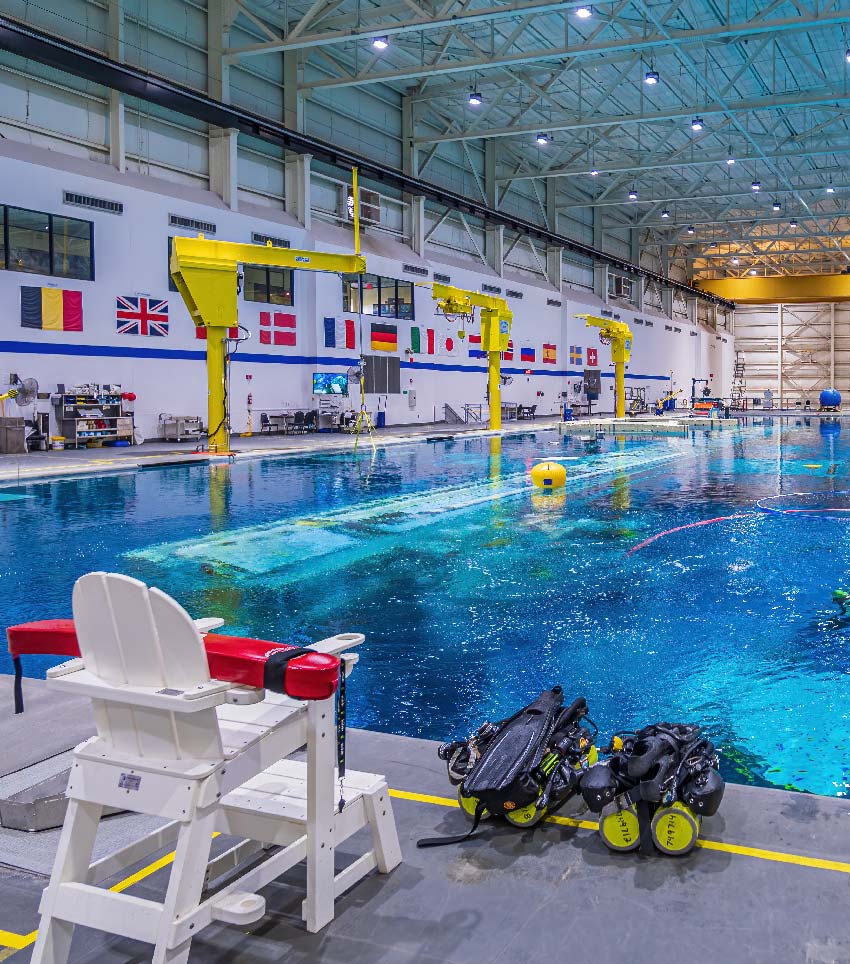
V2X has a proven history in enabling science in support of critical missions. One of our flagship programs representative of space science support is the NASA Neutral Buoyancy Laboratory (NBL) located at Johnson Space Center (JSC) in Houston, Texas. V2X provides highly skilled services that include enriched-oxygen breathing gas production (Nitrox), life-support systems for submersed space-suited subjects, spacewalk procedure development and verification, operation of human-rated robotic systems, integrated audio and video systems, Self-Contained Underwater Breathing Apparatus (SCUBA) training and evaluations, and computer network systems that are tied to International Space Station (ISS) simulations to generate emergency scenarios.
The NBL is a unique facility that is available 27/7 for critical training and mission support operations and is kept in a ready state to support the dynamic nature of human spaceflight. The 6.2-million-gallon pool, an essential tool for spacewalk training, simulates the weightlessness experienced by astronauts in space. This pool is 12 meters (40 feet) deep and roughly the size of 10 Olympic swimming pools.
For the past 30 years, it’s been used to help train astronauts for space exploration. The surface of the water is complimentary for practicing the recovery mission. That’s the final stage of spaceflight, when the capsule carrying crew members returns to Earth and splashes down into the ocean. Beneath the surface, the pool contains a replica of the International Space Station (ISS). Moving on and around this model, astronauts practice working in microgravity—the reduced pull of gravity that creates a sense of weightlessness in space.
Most recently, NASA and V2X have transformed the bottom of the pool into a realistic copy of the moon’s surface. With NASA now aiming to put astronauts on the moon, a part of the underwater facility has rapidly changed to accommodate this mission. Simulated sand and boulders (both natural and artificial) ornament the pool floor. Prototype spacesuits and lunar vehicles take dives. Even the strange sun conditions on the moon are coming into focus, as V2X experiments with the lighting that NASA astronauts will face at the moon’s south pole in 2025 or so, when Artemis 3 goes on the surface.
The simulation will be used as a training ground for NASA’s upcoming Artemis program. The astronauts flying this series of missions will include the first woman and person of color to visit the moon. It will mark humanity’s first return to the moon in more than half a century. The crew will land near the moon’s south pole, an entirely unexplored region. There, they’ll encounter huge craters, extreme temperatures, and areas of permanent darkness. It’s a fascinating and challenging environment to reproduce.
Astronauts heading to the moon will need to be comfortable moving in lunar gravity, which is about one sixth that on Earth. That’s where the NBL comes in. Before entering the pool, astronauts are outfitted with weights and floats to wear underwater. These alter the astronauts’ buoyancy—the upward force that acts on objects in a fluid—to mimic the moon’s gravity. The idea of using buoyancy to simulate the effects of reduced gravity has been around since the earliest spacewalks. Artemis astronauts need to get used to walking, kneeling, and using tools while wearing them. And since the suits weigh roughly 181 kilograms (400 pounds) on Earth, it’s much easier to practice those movements in the simulated reduced gravity of the pool.
The south pole of the moon—where future astronauts plan to land—is even more inhospitable than the areas Apollo astronauts explored. The angle of the sun keeps low-lying areas in permanent darkness and bitter cold. Craters make the ground uneven and hard to navigate. To mimic aspects of this environment, V2X placed huge natural and manufactured boulders at the bottom of the NBL pool. They built sloped panels into the floor so astronauts can practice navigating the region’s uneven terrain. Programmable LED lights simulate the movement of the sun and the region’s extreme shadows. Engineered sand mimics the lunar regolith—the layer of dusty debris that covers the moon’s surface. With no wind or flowing water on the moon, there’s no weathering to wear and smooth regolith particles. So, they tend to be jagged. Regolith can stick to surfaces and make them slippery. Astronauts must practice moving around and using tools in it.
While on the moon, Artemis astronauts will collect samples of rocks more ancient than the oldest one’s scientists have uncovered on Earth. They also plan to study permanently shadowed areas within the crater basins, where temperatures hover around -203°C (-333°F).
This exploration could require astronauts to walk on the moon for more than six hours at a time. In the NBL’s lunar environment, astronauts can practice these missions from beginning to end, simulating entire spacewalks in real time. During training, instructors can observe the crew through live video feeds and communicate through a tethered cable, helping astronauts become familiar with procedures and learn what to do if something unexpected happens.
The goal is to anticipate every situation the crew might encounter on the lunar surface and enable them to respond quickly. We do everything we can to prepare them so that these procedures become second nature.
Other moon work is also ongoing at the water surface level of NBL: V2X participated in simulated landing operations of the Artemis 1 mission after years of practice in the pool. That uncrewed 2022 mission not only sent the astronaut-rated Orion spacecraft around the moon for the first time but had a flawless splashdown in part due to years of training and preparation for recovery operations.
For the V2X team, the goal is to make the environment as close as possible to the real thing. There’s no room for surprises in an extreme environment like space. The realism of our simulations is directly tied to crew safety and mission success.
The NBL operations contract continues the innovative technical and engineering support V2X has provided since 2003 including extending the lifecycle of the massive underwater mockups of the ISS. V2X also helped NASA lower the overall operating costs of the facility by bringing in external customers who take advantage of the unique, fully instrumented underwater facility. Among other uses, customers use the facility to train for operating unmanned vehicles offshore and undersea, conduct experiments in a microgravity environment and test underwater equipment.
Focus on Innovation
With an experienced team focused on mission support and execution, V2X enhances capabilities and extends the service life of essential platforms and components.
Our intelligent sustainment solutions ensure that key systems, including power, sensors and platforms, can operate in any remote and austere conditions — reliably and at peak capacity. And we ensure that critical systems can quickly meet evolving needs, even in the face of emerging physical or environmental threats.
V2X also brings smart capabilities to facilities, such as 5G Smart Warehouses, or even entire campuses or bases. The result is greater readiness and a more cost-effective, reliability-centered maintenance approach.
Capabilities include, but are not limited to:
- Life Extension for Critical Platforms and Infrastructure
- Sensor and Platform Modernization
- Product Development
- Platform, System, Module and Component Level Repair and Overhaul
- Green Energy Solutions
Program Highlight: Indianapolis Laboratory Facility

V2X provides vertically integrated turnkey lifecycle support from concept definition, to engineering and manufacturing, through end-of-life support of complex systems. Our laboratory facility, located in Indianapolis, is a one million square foot facility that includes a significant organic engineering and manufacturing capability unlike any other in the world.
Within this laboratory, our engineering, software development, rapid prototyping and maintenance services on complex systems rivals capabilities found in many OEMs, but at a much lower cost. Our teams have the organic resources necessary to transition a mission need from concept definition through design, manufacturing, integration, and test to full lifecycle sustainment.
As a platform and systems agnostic integrator, we develop solutions that provide customers with true best of breed capabilities. Our engineering and manufacturing facilities offer a full suite of fabrication resources and in-house testing labs that reduce delays and needs for subcontractors.
M&S is active in the full U.S. Government product acquisition lifecycle including Contracted Research and Development (CRAD), Research Development, Test and Evaluation (RDT&E), production and sustainment. Ideas are developed from concept through sustainment, without requiring outside support that adds unnecessary time and cost. M&S solves customer problems from operational need to technical insertion, keeping fielded platforms relevant in today’s harsh environments. Because of this diverse manufacturing capability, rapid prototyping is available for nearly any need. The operation also houses a full MIL-STD-810 test capability, MIL-STD-461/2 EMI/EMC chambers, near and far field antenna ranges and a large centrifuge.
Approximately 350 engineering personnel who work on more than 400 projects requiring multiple engineering disciplines such as systems, software, hardware, electrical, mechanical and test, are resident and speed resolution of design and test needs.
Our portfolios and capabilities include:
- Design, Integration and production of multiple complex platforms and systems
- Full A-Kit and B-Kit development and installation
- Depot-level repair and overhaul of auxiliary systems including complex sensors and equipment
- Cybersecurity defensive capabilities
- Integrated platform system and subsystem connectivity
- Situational Awareness (SA) at the Tactical Edge
- Mission System capability federation and integration
- Stores Management System capability extension
- Specific expertise in rapid Systems & Software Engineering product discovery – rapidly designing, developing, deploying, and fielding capability
- Astronaut training and critical mission support services
Environment, Health, and Safety
In support of V2X’s vision and values, we are committed to Environment, Health, and Safety (EHS) excellence. The EHS Department is chartered with, and dedicated to, providing programs and practices that assist all employees in protecting each other, the communities we work in, and the customers we serve.
Environment Health and Safety Policy statement
V2X’s customized, streamlined Environment, Health & Safety Management System (EHSMS) supports our ‘Vector to Zero’ philosophy, which drives our efforts to continue the Path-to-Premier EHS Performance. It is designed to meet a continually evolving and dynamic business and operating model and follows the guidelines and principles outlined in recognized external management system standards (ISO 14001, ISO 45001, and ANSI/ASSP Z10.0).
V2X has several EHS programs designed to reinforce our safety culture and institute environmental stewardship. In 2016, the Royal Society for the Prevention of Accidents (RoSPA) presented the gold achievement award to V2X’s headquarters-based safety operation for individual occupational health and safety performance. V2X holds ISO 9001, ISO 14001, and ISO 45001 certifications in Germany.
V2X is committed to the continual improvement of our safety and health programs throughout our global footprint. We pay close attention to our safety and health performance metrics and conduct thorough incident investigations with associated corrective and preventative actions. Visit the Environment, Health, and Safety Metrics page to learn more.
V2X provides a wide range of customized environmental programs for our customers that address areas such as environmental education, energy and natural resources conservation, reduction and management of hazardous chemicals and waste, and recycling. Visit the Environmental Aspects and Impacts page to learn more.